
Due diligence · Sunshine Coast
What to ask a civil engineer before signing a land contract
The civil questions to ask before committing to Sunshine Coast development land, from access and drainage to services, survey limits and decision deadlines.
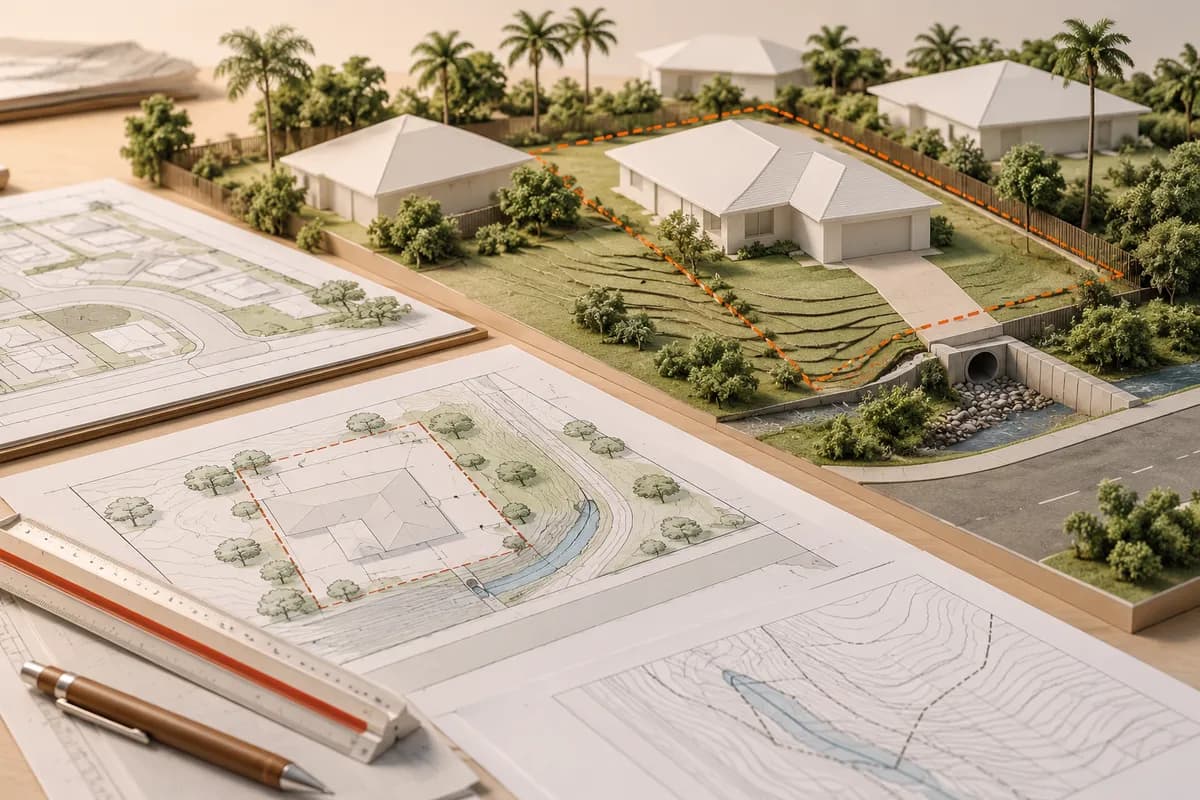
Concept illustration
Project question?
Check the civil constraints before committing to your next step.
Send CivilCity the address, current plans, approval stage and the issue you are trying to resolve. We will help scope the right civil engineering input for the project.
Quick answer
Before signing a land contract, ask the civil engineer to test the assumptions that could change your minimum acceptable outcome: access, levels, stormwater discharge, services, earthworks, retaining, frontage works and easements. Ask what is supported by evidence, what is provisional and what investigation would change the conclusion.
The best brief is not “is this block developable?” It is “can this site support this proposed outcome, on this programme, with these known constraints?” A useful answer may recommend a layout change, a targeted investigation, a contract condition or walking away. It should not pretend that a desktop review is a development approval.
Make the intended outcome explicit
A two-lot subdivision retaining an existing house has different civil questions from a townhouse or small commercial proposal. Give the engineer the concept, target yield, buildings to retain, access preference, decision deadline and the result that would make the purchase unattractive.
On the Sunshine Coast, a site can look straightforward in a listing while local slope, road frontage, flood behaviour, drainage corridors or network servicing change the practical pathway. Council's Development.i site report and planning scheme mapping are useful starting evidence, but they do not replace site-specific survey, authority advice or design.
Questions that should be answered before commitment
Use the answers to separate a manageable unknown from a risk that could invalidate the deal.
| Question to ask | Evidence or test | Why it matters |
|---|---|---|
| Can the intended access work in three dimensions? | Road frontage, survey levels, grades, sight distance and vehicle movement | A narrow or steep connection can reduce yield or require costly frontage work |
| Where can stormwater go? | Existing levels, downstream route, lawful discharge pathway and overland flow | An attractive layout may fail if its outlet is unavailable or unconfirmed |
| Can each lot or building be serviced? | Utility records, connection points, easements and authority process | Service corridors can consume land or require works outside the site |
| What earthworks are implied? | Contours, preliminary pads, retaining interfaces and ground information | Cut, fill and walls can change access, drainage and construction scope |
| What remains unknown? | Assumptions register and targeted investigation plan | The contract and feasibility model need visible uncertainty, not hidden optimism |
Example: the contract deadline is shorter than the investigation
Consider a buyer looking at a sloping Buderim site with a proposed rear dwelling and a shared driveway. The listing shows a broad backyard, but no current contour survey or drainage concept. The buyer has seven days to make a decision.
The engineer's first task is to identify the controlling questions, not draw a polished plan: can the driveway connect at a workable level, can runoff be managed without shifting nuisance flow, and can services reach the rear building without an unconfirmed easement? If those answers require survey or authority information that cannot be obtained in time, the buyer can take that uncertainty to the solicitor and commercial adviser rather than pricing it as zero.
The useful output is a decision register showing established facts, assumptions, proposed tests, consequences and the deadline for each answer. This is an illustrative process, not a prediction about any property or approval.
Ask about scope, exclusions and the next decision
A civil proposal should identify the documents reviewed, site visit limits, concept tested, disciplines excluded, authority interactions included or excluded and the next decision the work is meant to support. Ask whether the fee covers a written memo, marked-up plan, meeting, options comparison or further investigation brief.
Also ask what the review cannot establish. A civil engineer may identify that geotechnical testing, a detailed survey, utility confirmation, planning interpretation or legal advice is needed. That is useful risk control, not a failure of the review.
Checklist for your project brief
Send CivilCity enough context to scope the review around the purchase decision.
- Property address, lot and plan, contract timetable and available inspection access.
- Intended use, target yield, existing buildings to retain and the minimum acceptable outcome.
- Listing plans, survey, title and easement information, approval history, photographs and known service records.
- Concept sketch showing access, building areas, parking, likely drainage direction and any assumed connection.
- Questions ranked by what could change the purchase decision, not a generic request for ‘feasibility’.
- The decision you need to make and the format that will help you make it.
Common mistakes
Do not ask for a guaranteed yield from a sketch, rely on a nearby service as a confirmed connection, or let a low civil fee hide exclusions for survey, drainage or authority work. Do not share different concept revisions with different consultants.
Another mistake is waiting until after exchange to ask the civil questions. A review can still help later, but the leverage to negotiate time, conditions or price has usually reduced. Put unresolved engineering dependencies into the wider contract discussion with the appropriate adviser.
When to involve CivilCity
Involve CivilCity before signing when access, drainage, slope, servicing, easements or frontage works could change the intended development. Send the contract deadline and the minimum outcome so the review can be proportionate and decision-focused.
Common questions
Can a civil engineer tell me whether to buy the property?
A civil engineer can test physical and infrastructure assumptions and explain unresolved risks. The purchase decision also needs planning, legal, finance and commercial advice.
Do I need a full civil design before signing?
Usually not. A proportionate feasibility review can identify controlling constraints and the evidence needed before detailed design. The right scope depends on the intended development and contract deadline.
What if the vendor cannot provide a survey?
Ask what can be established from available records and whether a conditional offer, inspection access or targeted survey is needed. Do not treat missing levels as a harmless assumption when drainage or access controls the concept.
Official sources and further guidance
- Sunshine Coast Council: Development.i site report
- Sunshine Coast Planning Scheme 2014
- Sunshine Coast Council: development applications
- Unitywater: subdivisions
Use the current requirements for your property and proposal. Illustrative scenarios describe possible design issues; they are not reported client projects.
Discuss your project
Test the site before signing
Send the address, concept, available survey and contract deadline so CivilCity can scope a focused engineering due diligence review.