Approvals · Sunshine Coast
Common reasons Sunshine Coast development applications get delayed
A practical guide to common Sunshine Coast development application delays and how civil engineering, planning and documentation can reduce risk.
Project question?
Check the civil constraints before committing to your next step.
Send CivilCity the address, current plans, approval stage and the issue you are trying to resolve. We will help scope the right civil engineering input for the project.
Short answer
Development applications are often delayed when the proposal is not clear enough, the supporting information is incomplete, or key civil constraints are left unresolved. Sunshine Coast Council's application guidance points to forms, checklists and well-made application expectations, but the practical issue is coordination.
A good application should tell one coherent story across planning, survey, architecture, landscape and civil engineering.
Civil issues that trigger delays
Stormwater, lawful discharge, driveway access, sight distance, earthworks, retaining, services and infrastructure conditions are common technical pressure points. If these are vague at lodgement, the application may need further information or redesign.
A concept that works visually but cannot drain, be accessed or be serviced cleanly will usually slow down.
Documentation mismatches
Delays also happen when drawings do not match: civil levels do not align with architectural plans, landscape conflicts with drainage, survey levels are outdated, or parking layouts do not support vehicle movement.
Before lodgement, the consultant team should check whether the same driveway, retaining wall, basin, service corridor and lot boundaries appear consistently across the package.
How to reduce the risk
Use council checklists, confirm the assessment pathway, identify referral risks, prepare the right technical reports, and review civil constraints before the layout is fixed. If operational works is likely later, think ahead to the detail that will be required.
The best DA strategy is often to solve the hard site questions early, then lodge with confidence.
Use an information-request response register
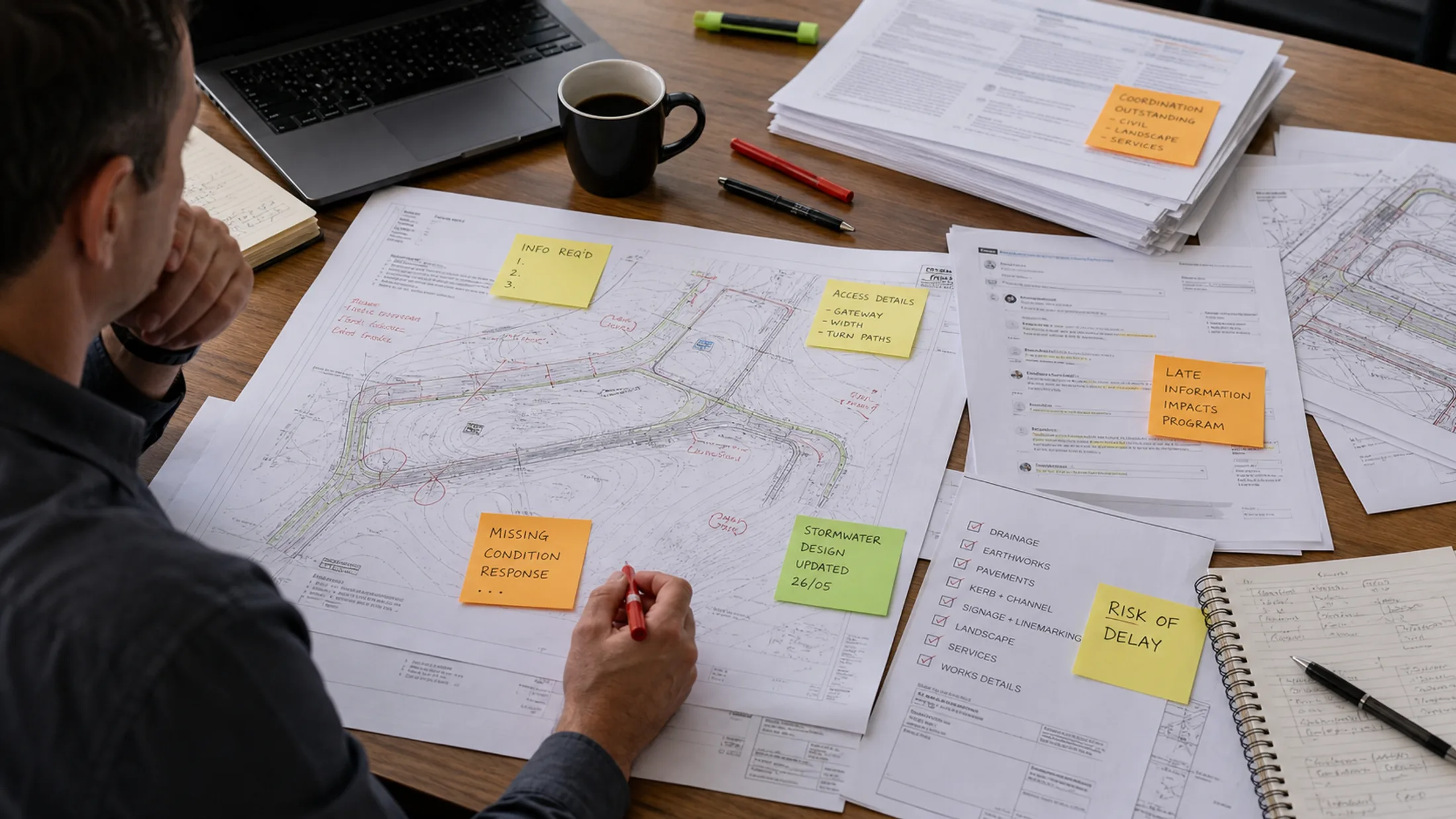
When an information request arrives, do not send each consultant away with only their own paragraph. A drainage response may move a retaining wall, which affects landscaping, building levels and the survey plan. Nominate a lead to track the affected documents and coordinate one consistent response. The aim is to answer the actual request with traceable evidence. A longer report is not necessarily a better response if it leaves the requested level, calculation or design outcome unclear.
| Decision or stage | Evidence to check | Practical outcome |
|---|---|---|
| Unclear request | Confirm the issue and the evidence needed with the assessment team. | Avoid solving the wrong problem. |
| Design change | Identify every drawing and report affected by the revision. | Keep architecture, civil and landscape aligned. |
| Submission | Provide a response schedule with references to revised material. | Make each answer easy to locate and assess. |
Example: a drainage revision affects three disciplines
Consider an information request asking the applicant to demonstrate a workable drainage outlet. The revised civil strategy moves a storage area into the landscape zone and raises an adjacent driveway. The response now affects landscape provision, vehicle grades and garage levels as well as stormwater. Have the lead consultant circulate a marked-up interface plan and identify every drawing that must change. Before submitting, compare the final revisions against the request and the proposal description. Resolving the pipe design while leaving the old landscape and architectural plans in the package creates a new inconsistency for the assessor to resolve.
Checklist for your project brief
Use these points to define the next investigation or consultant deliverable.
- Record the request item, responsible consultant, dependencies and agreed response date. Keep statutory process deadlines separate from internal production dates.
- Ask the engineer whether the proposed fix changes an approval assumption, cost or constructability. Tell the client before revising the package.
- Check revision numbers and superseded drawings before resubmission. An updated calculation paired with an old plan can generate another round of questions.
How CivilCity helps
CivilCity can support development applications with early access, stormwater, services, levels and constructability advice. This helps planners and designers avoid avoidable information requests and late redesign.
For developers, the value is momentum: fewer surprises, cleaner coordination and a clearer path to the next approval stage.
Common questions
What causes development application delays?
Common causes include incomplete information, unresolved civil constraints, inconsistent consultant drawings, unclear stormwater strategy, access issues, referral requirements and late changes.
Can every delay be avoided?
No, but many avoidable delays can be reduced by lodging a coordinated, well-made application with the right technical information upfront.
Why does civil engineering matter before lodgement?
Access, stormwater, levels, services and earthworks can all affect whether the planning layout is credible and easy to assess.
Official sources and further guidance
- Development application forms and checklists
- Lodging development applications
- Development.i
- Current Sunshine Coast Planning Scheme
Use the current requirements for your property and proposal. Illustrative scenarios describe possible design issues; they are not reported client projects.
Discuss your project
Planning-stage civil engineering
Share the proposal, current plans and approval stage to identify the civil evidence needed.