
Approvals · Sunshine Coast
Operational works application Sunshine Coast: what developers need before construction
A practical guide to Sunshine Coast operational works applications, civil drawings, approval conditions, RPEQ review and construction readiness.
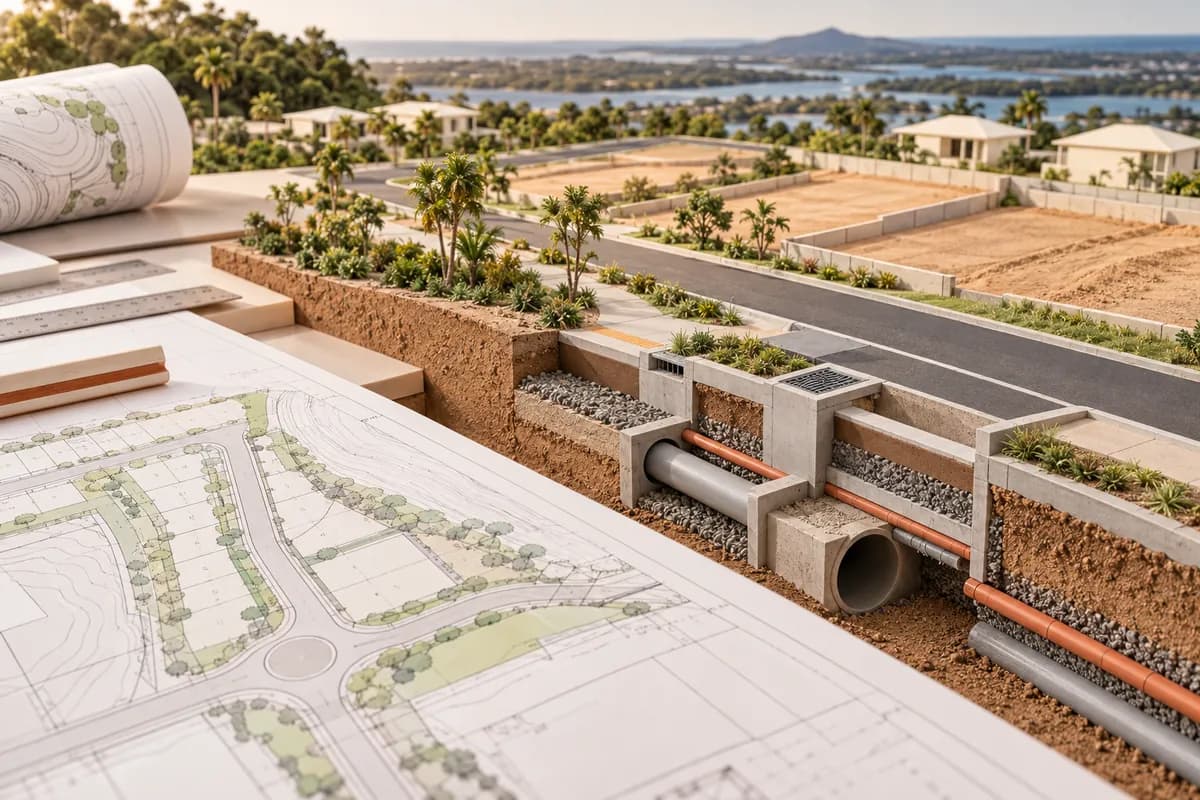
Concept illustration
Project question?
Check the civil constraints before committing to your next step.
Send CivilCity the address, current plans, approval stage and the issue you are trying to resolve. We will help scope the right civil engineering input for the project.
Quick answer
If your Sunshine Coast development approval includes civil works, frontage works, stormwater, earthworks, access upgrades or infrastructure conditions, you may need an operational works application before construction can start.
The practical question is not just whether you have an approval. It is whether the approval conditions can be turned into buildable civil drawings, technical responses and a construction-ready package without reopening the layout, levels or drainage strategy.
Why operational works matters
Operational works is where optimistic planning drawings meet engineering detail. Driveway grades, stormwater pits, pipe levels, retaining, pavement, frontage works, erosion control and service clashes become real design decisions.
For developers, this stage can either keep the project moving or expose gaps left during the development application. A vague condition can become a redesign if the site was not tested properly before approval.
| Trigger | What to check | Why it matters |
|---|---|---|
| Stormwater works | Discharge point, levels, detention and water quality | Late drainage changes can affect lots, buildings and retaining. |
| Access or frontage works | Driveway grades, sight distance, kerb, road and footpath interfaces | The approved layout still needs to work at construction detail. |
| Earthworks | Cut, fill, retaining, boundaries and adjoining land | Small level changes can create expensive walls or drainage issues. |
| Approval conditions | Civil drawings, reports, certifications and staging | Missing one condition can delay construction and closeout. |
What a strong package should include
A useful operational works package normally starts with the approval conditions, stamped plans, current survey, civil concept, service information and any earlier stormwater or traffic advice. The civil drawings should then show enough detail for assessment, tendering and construction coordination.
Depending on the project, the package may include stormwater layout, drainage long sections, earthworks, retaining interfaces, driveway or road details, pavement, erosion and sediment control, service coordination notes, construction staging and RPEQ certification where required.
Common mistakes
The expensive mistake is treating operational works as drafting. If the planning-stage concept did not test levels, drainage, access and services, the operational works engineer may inherit a drawing that cannot be built cleanly.
Other common mistakes include relying on old survey, ignoring service clashes, underestimating stormwater treatment, assuming a condition can be handled later, and failing to coordinate the builder, planner, surveyor and engineer around the same drawing set.
Brief the engineer with a condition-to-deliverable schedule
This article focuses on appointing and briefing the civil designer for the application package. A useful proposal links each relevant condition to a drawing, report, calculation, certificate or authority interface. It should also identify exclusions and information needed from others. Do not assume the design fee includes construction inspections, contractor queries or as-constructed documentation. Agree those services before work starts so the evidence needed for closeout can be collected in time.
| Decision or stage | Evidence to check | Practical outcome |
|---|---|---|
| Input package | Decision notice, approved plans, survey and existing reports. | Give the designer a reliable starting point. |
| Application scope | Defined sheets, calculations and authority responses. | Compare proposals on equivalent deliverables. |
| Delivery support | Inspections, changes and closeout records. | Avoid an unfunded gap after drawings are issued. |
Checklist for your project brief
Use these points to define the next investigation or consultant deliverable.
- Provide the complete decision notice, including referenced plans and amendments. Identify construction timing and unresolved conditions.
- Ask the engineer to list dependencies on geotechnical, structural, landscape, survey and service-authority inputs.
- Confirm revision allowances and who will respond to assessment queries. A lodged package is not the same milestone as an accepted construction design.
When CivilCity should be involved
Bring CivilCity in as soon as approval conditions are issued, or earlier if the development application is likely to generate civil conditions. The best brief includes the approval, stamped plans, survey, title information, existing reports and the construction timing you are trying to protect.
CivilCity can review the conditions, identify the operational works deliverables, prepare civil drawings, coordinate technical responses and support the project through construction-phase questions and closeout planning.
Common questions
When does a project need an operational works application?
Operational works is commonly needed when approved development requires detailed civil infrastructure, earthworks, stormwater, road, access or frontage works before construction can proceed. The exact trigger depends on the approval conditions and project scope.
Is operational works the same as a development approval?
Operational work is itself a type of development. An operational works approval is distinct from an approval for a material change of use or reconfiguring a lot; one does not automatically authorise all the other work.
Who prepares operational works drawings?
A civil engineer usually prepares the civil drawing package, technical notes and supporting information, with appropriate RPEQ responsibility for professional engineering services and any separately required certification.
Can CivilCity help after conditions have already been issued?
Yes. CivilCity can review the approval conditions, identify the civil deliverables, prepare or coordinate the engineering package and support responses through the operational works stage.
Official sources and further guidance
- Council operational work requirements
- Sunshine Coast Council development applications
- Sunshine Coast Planning Scheme 2014
- Unitywater subdivision servicing pathway
Use the current requirements for your property and proposal. Illustrative scenarios describe possible design issues; they are not reported client projects.
Discuss your project
Operational works applications
Send the decision notice, approved plans and survey to define the engineering package.