
Planning · Sunshine Coast
Bushfire hazard overlay Sunshine Coast: subdivision and development checks
How the Sunshine Coast bushfire hazard overlay can affect subdivision, access, building envelopes, setbacks and development application material.
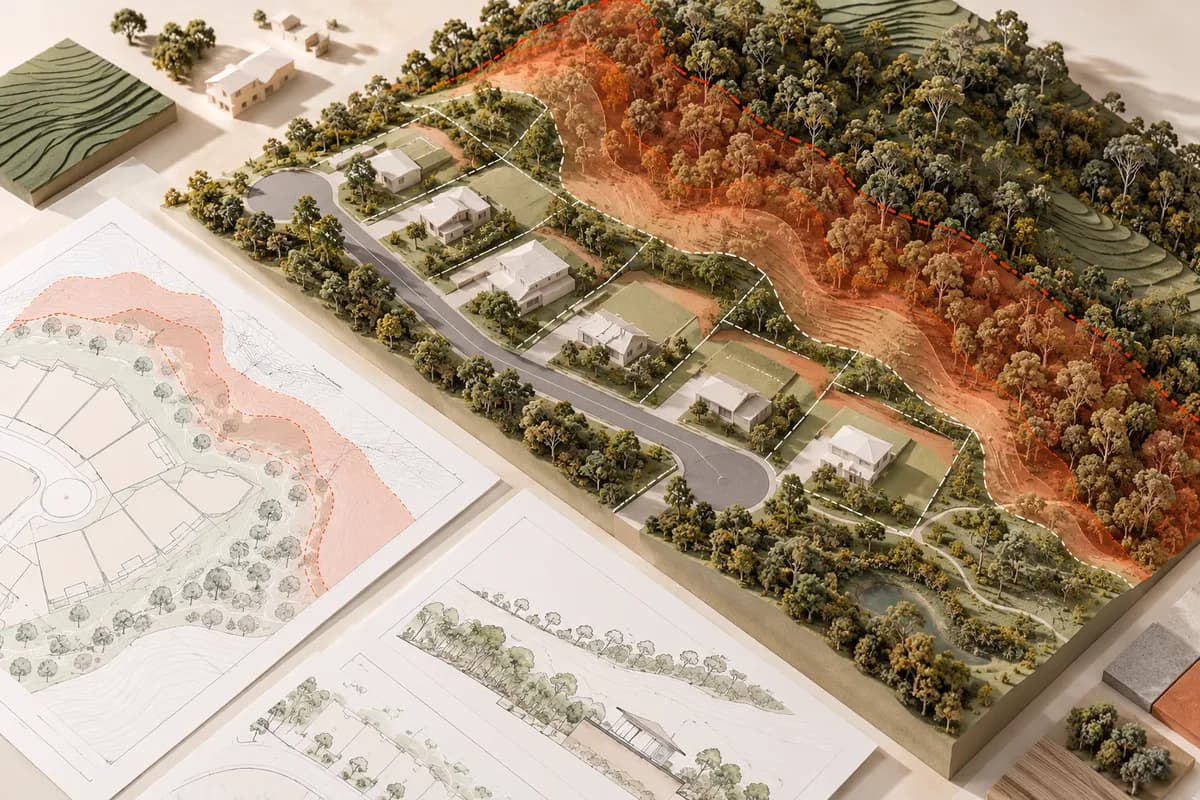
Concept illustration
Project question?
Check the civil constraints before committing to your next step.
Send CivilCity the address, current plans, approval stage and the issue you are trying to resolve. We will help scope the right civil engineering input for the project.
Why bushfire belongs in the civil feasibility conversation
Bushfire is often treated as a specialist planning or bushfire-consultant topic, but it affects civil layout. Access, road design, lot layout, building envelopes, vegetation retention, water supply and emergency movement can all become relevant.
The Sunshine Coast Planning Scheme includes Part 8 Bushfire hazard overlay code material, Part 5 assessment triggers and SC6.7 planning scheme policy guidance. Biodiversity overlay provisions can also interact with bushfire constraints and may require greater setbacks in some circumstances.
The overlay can change the project shape
For subdivision, bushfire constraints can influence where lots and building envelopes sit, how access roads are designed, whether vegetation is retained or cleared, and what supporting reports are needed. A layout that looks efficient on paper may become awkward if bushfire separation, access and ecological constraints pull in different directions.
SC6.7 planning scheme policy material includes advice about achieving outcomes in the Bushfire hazard overlay code and guidance about information that may be required to support a development application. Use the specialist assessment to define constraints on a shared site plan.
Civil checks to run with bushfire advice
Check whether the access arrangement supports emergency movement, whether road widths and turnarounds are practical, whether water supply arrangements are clear, and whether building envelopes can sit outside the most constrained parts of the site.
If biodiversity, waterways, steep land or flood overlays also apply, the design needs a coordinated response. Moving a driveway to solve bushfire access can create stormwater, earthworks or ecological impacts elsewhere.
When to involve consultants
For mapped bushfire hazard sites, involve the planner, bushfire consultant and civil engineer early. The team can then test whether the lot layout, access, services and stormwater strategy are compatible with the bushfire response.
A shared constraints plan helps identify conflicts between emergency access, vegetation retention, drainage and building envelopes before separate reports are finalised.
Check the civil layout against the specialist response
The bushfire consultant establishes the site-specific assessment and recommendations within their scope. The civil team then needs to test whether access, turning, water-supply arrangements and earthworks can accommodate that response. On a vegetated sloping property, widening an access route may affect clearing, retaining and drainage. Bring ecological and planning advice into the same discussion where relevant. Do not treat one discipline’s recommended line on a plan as proof that it can be built or approved.
| Decision or stage | Evidence to check | Practical outcome |
|---|---|---|
| Building envelope | Bushfire advice and vegetation constraints. | Agree an area that can also be accessed and serviced. |
| Emergency access | Required operating arrangement and surveyed geometry. | Test grades, turning and construction implications. |
| Water and maintenance | Specialist requirements and service strategy. | Clarify access and ongoing responsibilities. |
Resolve competing spatial requirements before final reports
A concept can appear to satisfy individual requirements while allocating the same area to vegetation retention, access and another purpose. Ask the consultant team to mark these requirements on one plan with clear dimensions and ownership assumptions. If an access route changes, check whether the change affects the specialist assessment or requires additional clearing and earthworks. Resolve that conflict before lodging final reports. The coordinated plan becomes the reference for the subsequent engineering design rather than a collection of separate recommendations that the contractor must reconcile.
Checklist for your project brief
Use these points to define the next investigation or consultant deliverable.
- Use a shared base plan for vegetation, buildings, roads, services and drainage so conflicts are visible early.
- Ask specialists to state the assumptions they need the civil design to satisfy, rather than leaving those interfaces implicit.
- Recheck the coordinated response when the lot layout changes. A new boundary or building envelope can alter the feasibility of the original measures.
How CivilCity helps
CivilCity can work with bushfire and planning consultants to test access, road geometry, stormwater, services and construction constraints for Sunshine Coast subdivision and development sites affected by bushfire mapping.
Common questions
Does bushfire mapping mean a site cannot be developed?
Not automatically. It means the hazard and relevant assessment benchmarks need to be checked and the design may need a specific response.
Why does a civil engineer care about bushfire?
Because bushfire responses can affect access, road layout, turnarounds, water supply, building envelopes and earthworks.
Should bushfire be checked before subdivision layout?
Yes. It can affect lot layout and access strategy, so it should be reviewed before the concept plan is treated as fixed.
Official sources and further guidance
Use the current requirements for your property and proposal. Illustrative scenarios describe possible design issues; they are not reported client projects.
Discuss your project
Early civil engineering advice
Share the site report and concept to identify the civil investigations that matter.