
Access · Sunshine Coast
Driveway long sections and cross sections explained
A practical guide to driveway long sections and cross sections for Sunshine Coast homeowners, designers and developers.
Project question?
Check the civil constraints before committing to your next step.
Send CivilCity the address, current plans, approval stage and the issue you are trying to resolve. We will help scope the right civil engineering input for the project.
Short answer
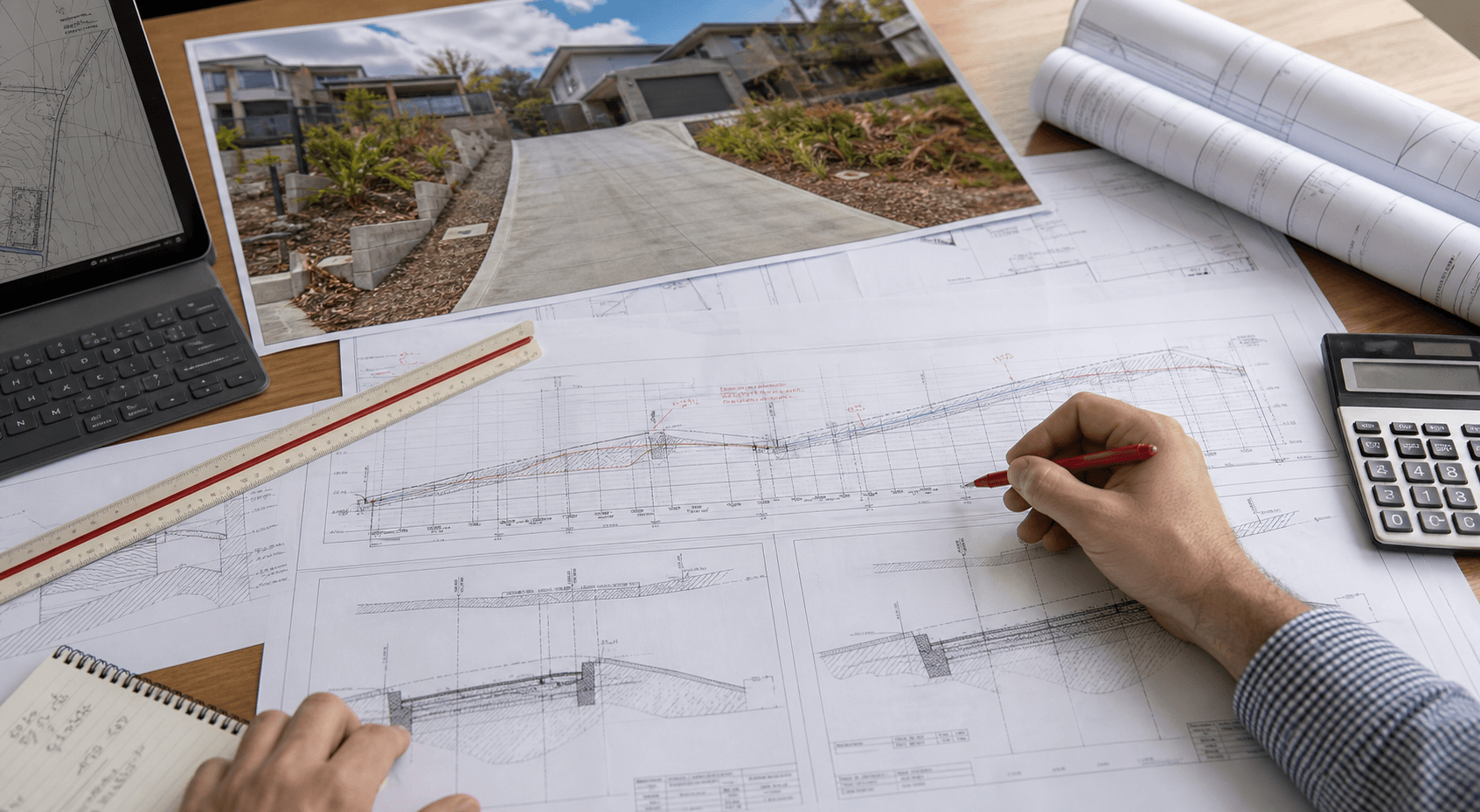
Driveway long sections and cross sections are the drawings that prove a driveway works in three dimensions. A plan view shows where the driveway goes. The sections show whether it can actually climb, fall, drain and meet the road or garage properly.
For Sunshine Coast sites with slope, narrow frontage or rear access, these drawings can be the difference between a workable access and a redesign.
What the long section shows
The long section shows the driveway profile from the road frontage through to the parking area or garage. It sets out road levels, boundary levels, grade changes, transitions, crests, sags and finished levels.
This is where scraping risk, excessive slope, poor transitions and awkward garage levels become visible.
What the cross section shows
The cross section shows driveway width, cross-fall, pavement shape, retaining needs, edge conditions, drainage channels and the relationship to adjoining ground.
It is especially useful where the driveway cuts across a slope or sits close to boundaries, buildings, fences or landscape areas.
When to request them
Request sections early for steep sites, rear lots, battle-axe access, townhouse projects, basement or podium access, or any site where road level and building level are not close.
They should be prepared before garage levels, finished floor levels or subdivision access handles are treated as fixed.
How to read the drawing at a design meeting
Follow the driveway from the road to the destination using its chainages, the distances measured along the alignment. Compare existing ground with the proposed surface, then locate each grade change. The long section shows the vertical journey; a cross section explains what happens sideways at a particular location. If the drive is beside a boundary, the cross section may reveal retaining or drainage works that are not obvious in plan. Ask the designer to explain the critical vehicle-clearance check and the levels still awaiting confirmation.
| Decision or stage | Evidence to check | Practical outcome |
|---|---|---|
| Long section | Existing and proposed levels, grades and transition lengths. | Can the nominated vehicle negotiate the vertical changes? |
| Cross section | Width, crossfall, wall or batter and adjoining ground. | Where do runoff and structural support fit? |
| Plan view | Alignment, boundaries, gates and parking. | Does the three-dimensional design match the latest layout? |
Use the sections to resolve a level conflict
If a proposed garage level produces an abrupt driveway transition, ask the designer to compare moving the garage level, changing the alignment and adjusting the transition length. Check each option against parking, drainage and boundary retaining. The plan and sections should be revised together: a workable vertical profile on an outdated alignment is not a coordinated design. Before construction, confirm that the survey and issued drawings use the same datum and that the contractor understands the setting-out levels. If actual frontage conditions differ, obtain design direction before adjusting levels on site, because a small local change may affect the remaining profile.
Checklist for your project brief
Use these points to define the next investigation or consultant deliverable.
- Check the datum, survey date and drawing revision. Mixing assumed garage levels with a different survey datum can make an apparently precise section misleading.
- Mark the road tie-in, boundary, gate and garage on the section. Ask which points are fixed and what moving them changes elsewhere in the design.
- Review sections through pinch points rather than only a typical detail. A retaining wall or service conflict may occur at one specific chainage.
How CivilCity helps
CivilCity can prepare and review driveway long sections and cross sections to test grades, levels, drainage and buildability.
For homeowners and small developers, this gives a clear answer to a practical question: will the driveway actually work once it leaves the paper?
Common questions
What is a driveway long section?
It is a drawing that follows the driveway along its length, showing levels, grades and transitions from the road to the parking or garage area.
What is a driveway cross section?
It cuts across the driveway width to show cross-fall, edges, retaining, drainage and how the driveway sits against adjoining ground.
Why do these drawings matter?
They reveal whether the driveway can actually be built, drained and used safely, especially on sloping or constrained sites.
Official sources and further guidance
Use the current requirements for your property and proposal. Illustrative scenarios describe possible design issues; they are not reported client projects.
Discuss your project
Access and parking investigations
Share the layout, survey and intended vehicle movements to define the access checks.